
Stuck on Mount Stupid: How AI tricks Us into Thinking We're Experts
AI tools make us feel like experts until real-world challenges prove otherwise. Here is how overdependence on AI distorts knowledge and threatens genuine skill acquisition.
By Youmbi Leo
- Artificial Intelligence
- Software Engineering
- Psychology

Personally…
I recently had the privilege of being one of the few shortlisted and called for a technical interview in a big tech company in my country. We were given a couple of “tagged-easy” DSA problems to solve, but trust me, they were everything but easy.

And it seemed to me as we all (the candidates) shared the same difficult experience.
I believed that since I had experience building projects, mostly using an AI harness, everything should have gone well. I over-estimated my capabilities/competence in DSA problems solving. And this, my dear reader, is the symptom of the Dunning-Kruger Effect.
Understanding the Dunning-Kruger Effect
A formal definition would be: a cognitive bias whereby people with limited knowledge or competence in a given intellectual or social domain greatly overestimate their own knowledge or competence in that domain. (source, Britannica)
In layman’s terms, it is when someone with low ability in a particular area overestimate his/her competence. It is not necessarily arrogance; it is about not knowing what you don’t know.
You are surely familiar with the concept: Imposter’s Syndrome. Well, it ‘can’ be considered the opposite of the D-K effect.
The Illusion of Competence
Knowledge has become so accessible nowadays with the advent of AI. Just a single “What is ..” search and the AI mode brings out a full summary of the topic. The drawback of this is that people, not only take this as the absolute truth, but also, do not realize how shallow that knowledge actually is.
Imagine someone — let’s call him Steven — wants to understand the economics of inflation and deflation. Instead of reading a textbook or studying market dynamics, he asks an AI tool for a quick explanation. The AI gives him a neat, 3-bullet answer: it defines the terms, attributes inflation to supply and demand imbalances, and notes that central banks adjust interest rates to fix it. Steven walks away feeling like an expert. Armed with this "deemed-deep" knowledge, he jumps into debates with actual economists, confidently spouting oversimplified answers to incredibly complex financial problems. I know we all have a Steven in our lives… and thanks to instant AI summaries, it’s easier than ever to accidentally become one.
The Crutch Effect
This superficial understanding is creating a bigger issue: we are neglecting actual skill acquisition and coming to rely almost entirely on AI to do the heavy lifting. For instance, a marketing director might rely on AI to generate flawless campaign strategies, yet lack the real-world intuition to diagnose why a failing ad isn't converting. Similarly, a developer can use AI to auto-generate code, but when a complex bug hits production, they struggle to debug it because they never mastered the underlying logic.
An esteemed senior of mine, Ms. Delia Ayoko, back at the Google DevFest 2024, gave a talk titled “Human Overdependence on AI”. A key insight I took away was that real learning happens at the human level: it’s through actually putting in the work and pushing through the struggle that our brain creates new neural connections, building genuine competence that no AI tool can replicate.
The D-K Curve
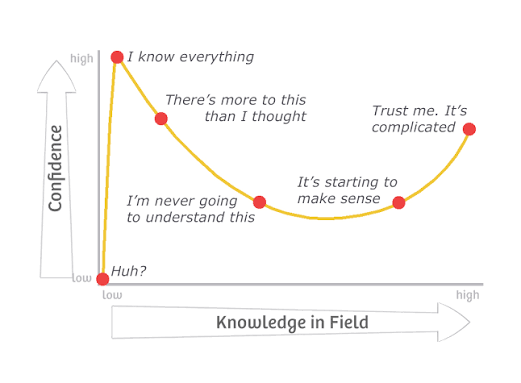
This curve best shows the difference between perceived ability and actual ability. The Dunning-Kruger curve illustrates this psychological trap. Beginners start at the “Peak of Mount Stupid” or the “I know everything” stage where minimal knowledge produces maximum confidence. As they learn more, they plunge into the “Valley of Despair” realizing how vastly complex the domain actually is.
AI creates a shortcut straight to the peak. By supplying quick answers, it lets users bypass the initial learning friction, giving them peak confidence without ever pushing them down the curve toward actual understanding. Real mastery requires pushing through the valley, confronting what you don’t know, and slowly climbing the slope of enlightenment through deliberate practice and hands-on trial and error.
Final Thoughts
Please, don’t misunderstand me: I am not condemning the use of AI. It remains an extraordinary tool for productivity and learning when used intentionally. However, we must treat it as a stepping stone rather than a replacement for deep thinking. Real expertise requires intellectual humility. As Socrates famously observed, “The only true wisdom is in knowing you know nothing.” By acknowledging the limits of our knowledge, we can leverage AI to accelerate our growth without falling into the trap of superficial competence.
Conversation
Comments12
Have a thought on this piece?
Sign in with Google to comment and reply. Only your name and profile photo appear beside what you write.